

Tuzla (Bosnia): building solidarities – "The challenge is that people become more aware of their common strength, to build a cohesive society"
RADOMIROVIC Miroljub, ALEKSIC Kassia
Interview with Miroljub Radomirović, jurist, and founding member of the Bosnian political party "Lijevi", "Left".
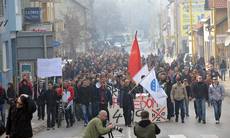 On 5 February, people set fire to the government building of Tuzla Canton, rebelling against criminal privatization, unpaid wages, and the corrupt ruling oligarchy. Violence was deemed necessary for people to finally get their voice heard, and overcome poverty. Ministers have resigned, and people have been taking control over political life. Soon after, more than 700 citizens gathered in Plenums, where they practice direct democracy. This "Tuzla effect" has spread throughout other towns in Bosnia Herzegovina... and this blast of anger has gained the streets in Croatia, Montenegro, Macedonia, in such a way that we're already speaking, in France and in Europe, of a Balkan "spring".
But in Tuzla, prospects go beyond a single season. People have been waiting for this moment for twenty years. The situation is charged with such hopes that it is better to hold on to reality – and keep a distance from the vertigo of such an ongoing revolution. It's a matter of proceeding step by step, to build solid bases for a political and social justice meant to last, by being very concrete.
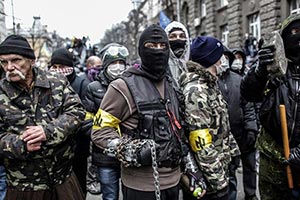 Sascha, Andrei, and Mira are members of AntiFascist Union Ukraine, a group that monitors and fights fascism in Ukraine. We sat down to talk about the influence of fascism in EuroMaidan, this is what they told me :
 The socialist union "Left Opposition" offers its assessment of the Russian aggression in Crimea and the destructive role of Ukrainian nationalists. The intervention of Russian armies was made possible as a result of a split in Ukrainian society. Its unity is impossible with the oligarchs and chauvinists in power. Only solidarity will save Ukraine.
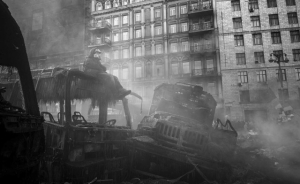 For weeks and weeks, we have been looking at Ukrainian events, trying to make sense of what has been happening in Kyiv and other cities. We had read many texts, comments and interviews and discussed about Maidan, but we had been always arriving only at new questions to be answered. Thus, when a possibility occurred to get in touch with Ukrainian comrades one of us tried to use it as best as he could. As a result of that effort and thanks to kindness and patience of Denis from a Kyiv branch of a revolutionary syndicalist group called Autonomous Workers Union the following interview came into existence. Hopefully, it will provide you with many useful insights into the Maidan movement and its context.
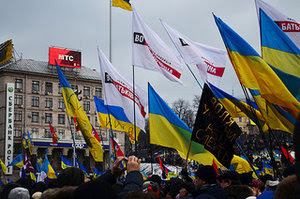 La chute de Ianoukovitch n’est pas “un coup” fasciste ; mais la composition et les orientations du “gouvernement d’union” soutenu par les puissances occidentales vont faire exploser l’Ukraine.
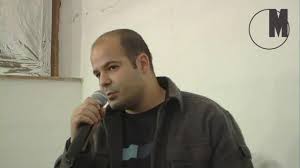 In Kiev tens of thousands risk their lives to protect the Maiden from police aggression. A participant in the January protests, socialist activist Ilya Budraitskis, argues that the left needs to be a stronger and more visible force in the movement.
 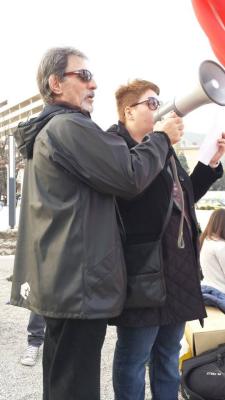 Every day more and more citizens are overcoming their fears and misconceptions and joining the protest movement in Mostar, one of the most essential cities active in the current uprising in Bosnia and Herzegovina. They gather every day, and have plenums (popular assemblies) a few times a week. They teach themselves direct democracy and activism – they will not be victims anymore. They are building civil power through direct action, and aim to reclaim their lives – the war is not over.
 As "Borotba" predicted in the November-December, victory of Maidan will lift to power ultraliberal and Nazi block. Approximate composition of new government recently published just proves our conclusion.
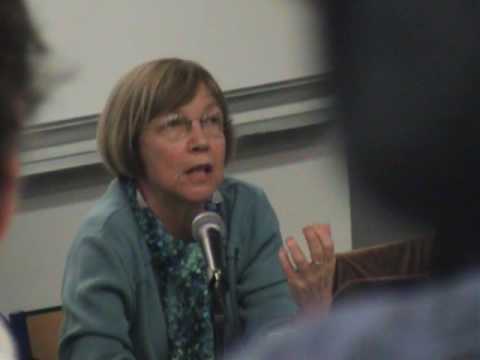 Près de 80 morts sur les pavés de Maïdan, devenus les martyrs du peuple tout entier révolté, ont fait basculer une part importante de l'appareil politique et policier du président Ianoukovitch, se déclarant « du côté du peuple ». S'agit-il d'une sortie de crise ?
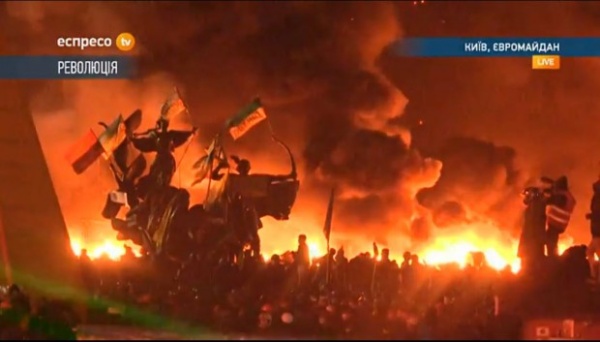 Back in mid-December, our estimate of Ukraine's political crisis as a "revolutionary situation" resulted in a lot of critical reviews. Further, the use of the word "revolution" in the context of Ukraine was condemned as a kind of sacrilege, because the events in Kiev appeared to be totally incomparable to the grandeur of past revolutions. There are no proclamations about the beginning of a new world, and no discussions of the socialization of property, while the social order established over the last two decades of post-Soviet rule has itself not been called into question. But a revolution's political content may not totally correspond to its dynamics: the masses' actual experience, their determination and ability to organize on their own, may be far ahead of their "political imagination." And if the revolution fails simply by virtue of a lack of independent political projects, it never ceases to be a revolution.
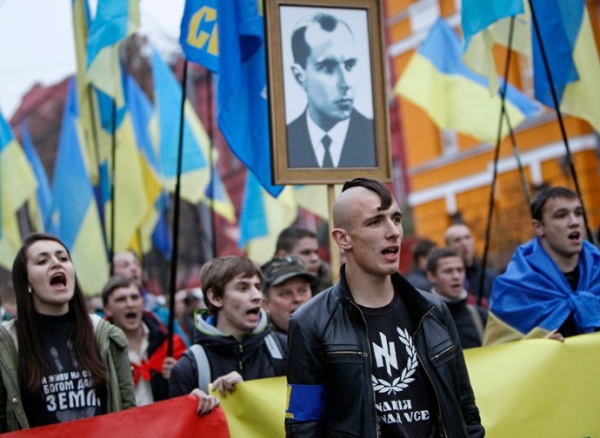 Depuis que l’Ukraine a refusé de signer un accord d’association avec l’Union européenne, d’imposantes manifestations pro-européennes ont lieu à Kiev, la capitale. En leur sein, on trouve paradoxalement des partisans de la formation politique ultra-nationaliste Svoboda. Une présence qui mène Louis Monnier, professeur d’histoire-géographie à la retraite, à relater une scène à laquelle il a assisté il y a quelques mois.
 En 2014 nos encontramos ante una situación extremadamente difícil, una situación límite, de emergencia social, que nos convoca a dar una respuesta colectiva y masiva de la clase trabajadora, la ciudadanía y los pueblos.
 Parce-que tout simplement, sans cultiver la terre et sans manger, un autre monde n’est pas possible. N’oublions pas que dans les pays en crise, se nourrir redevient une priorité absolue.
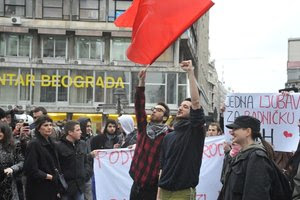 We, the undersigned, express our full support for the legitimate demands and justified outrage of citizens of Bosnia-Herzegovina. Their cry for a decent life, true democracy, solidarity that knows no borders—be them ethnic, national or religious, social equality and justice—resonates throughout the world. In a similar fashion to the citizens of Tahrir, Zuccotti Park, Taksim or Syntagma, the Bosnian protestors showed a courage to go beyond all institutional obstacles and all limitations that governments around the world impose on their citizens and reclaimed their streets and squares. The people of Bosnia-Herzegovina are standing against the system of exploitation, injustice and inequality that has been serving only and exclusively a tiny political, economic and financial elite.
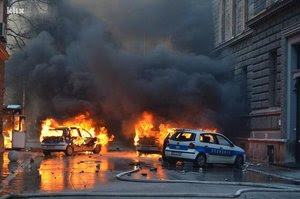 Le printemps est en avance sur le froid qui règne. Nul ne sait jusqu'où ira l'explosion sociale et démocratique. Mais dores et déjà, on sait qu'elle laissera des traces profondes et pourrait faire tâche d'huile : les peuples de la région commencent à voir « ce qui fait système », tant dans les griefs que dans les aspirations exprimées. De la dénonciation des « privatisations criminelles » on pourrait voir émerger celle des institutions euro-atlantistes qui les ont encadrées.