

ALAIN KRIVINE EST MORT
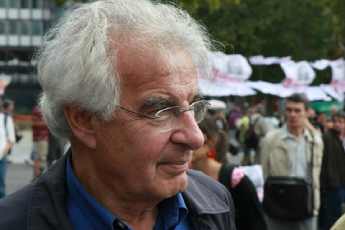 Notre camarade Alain Krivine nous a quittés aujourd’hui, à l’âge de 80 ans. Nous, camarades du NPA, nous associons à la douleur de sa famille, de ses proches, et de toutes celles et tous ceux qui se sont reconnus dans les combats qu’il a menés.
Durant plus de 65 ans, Alain a été un infatigable militant, présent dans toutes les luttes contre les ravages du système capitaliste, contre les injustices, pour l’émancipation.
Militant exclu du PCF, fondateur et dirigeant de la JCR, de la LCR puis du NPA, dirigeant de la IVe Internationale, Alain n’a jamais renié ses engagements de jeunesse. Il a été, pour des générations entières de militant·e·s, un modèle de constance, une intarissable ressource, un camarade exemplaire.
Nous nous souviendrons de son abnégation, de sa chaleur, de son humour. Jusqu’à la fin de sa vie, Alain n’aura rien lâché et n’aura pas cédé à la pression du « Ça te passera avec l’âge ».
 I want to go into the question of the resistance movement in Europe between 1940 and 1944 in detail. I want to do so especially because some comrades for whom I have respect, and whom I hope to see back in the Fourth International, the comrades of the Lutte Ouvrière group in France, have made it their special point of honour to raise this question against the Fourth International.


 Professor Julia Steinberger researches and teaches in the interdisciplinary areas of Ecological Economics and Industrial Ecology. Her research examines the connections between resource use (energy and materials, greenhouse gas emissions) and societal performance (economic activity and human wellbeing). She is interested in quantifying the current and historical linkages between resource use and socioeconomic parameters, and identifying alternative development pathways to guide the necessary transition to a low carbon society. She is the recipient of a Leverhulme Research Leadership Award for her research project ‘Living Well Within Limits’ investigating how universal human well-being might be achieved within planetary boundaries.
 It is not an exaggeration to say that what is currently happening in the heart of the European continent is the most dangerous moment in contemporary history and the closest to a Third World war since the Soviet missile crisis in Cuba in 1962.
 Nous nous sommes connus, Helena et moi, fonctionnaires du Service national de la santé au Chili, et nous étions aussi des syndicalistes. L’action syndicale fut sa première expérience, dans la voie d’une prise de conscience aigüe sur les inégalités qui divisent la population des sociétés capitalistes et de la nécessité de se battre pour y mettre fin.


 On 23 June 1921, a gathering of about 20 Communists in Moscow founded an international association to unify “revolutionary proletarian sports and gymnastics organizations … into support centers for the proletariat in its class struggle.”
 Below is the transcript of a talk titled “Marxism, socialist strategy, and the party” by Gilbert Achcar, which was delivered to the South African initiative,

 The pandemic we’re coping with is a zoonosis. Zoonoses are infectious diseases caused by pathogens jumping species from animals to humans. The pathogen may be a virus, a bacterium or a prion.

 Toute révolution est, comme l’écrivait Walter Benjamin, « un saut de tigre dans le passé » : ce fut le cas de la Commune de Paris de 1871, qui avait, dans la Commune parisienne de 1793-94 une de ses principales références ; et le même vaut, comme nous verrons plus loin, pour la Révolution russe, par rapport à la Commune de 1871.